The Port of Tianjin International Cruise Terminal witnessed a “three-ship docking” event on the first day of the National Day holiday, with Tianjin Maritime authorities working tirelessly to support the waterway passenger operations peak.
On the morning of October 1, accompanied by the autumn sea breeze, three passenger ships, “Aida Mediterranean,” “Ideal,” and “New Golden Bridge V,” smoothly docked at Tianjin International Cruise Home Port, creating a spectacular scene of “three ships docking simultaneously.” On the first day of the National Day holiday, the Tianjin Maritime Safety Administration worked tirelessly to ensure water safety, escorting passengers to start their water journeys safely.
With three passenger ships docking in quick succession, the cruise home port ushered in the peak period of passenger boarding and disembarking. Facing the severe situation of multiple ships docking simultaneously, high navigation density, concentrated passenger flow, and busy operations, the Tianjin Maritime Safety Administration made early arrangements and implemented precise measures. It strictly adhered to the “one ship, one plan” comprehensive chain fine-tuned security model, tailoring safe navigation and service support plans for each passenger ship entering and leaving the port, fully safeguarding the safety, convenience, and efficiency of water travels in its jurisdiction.
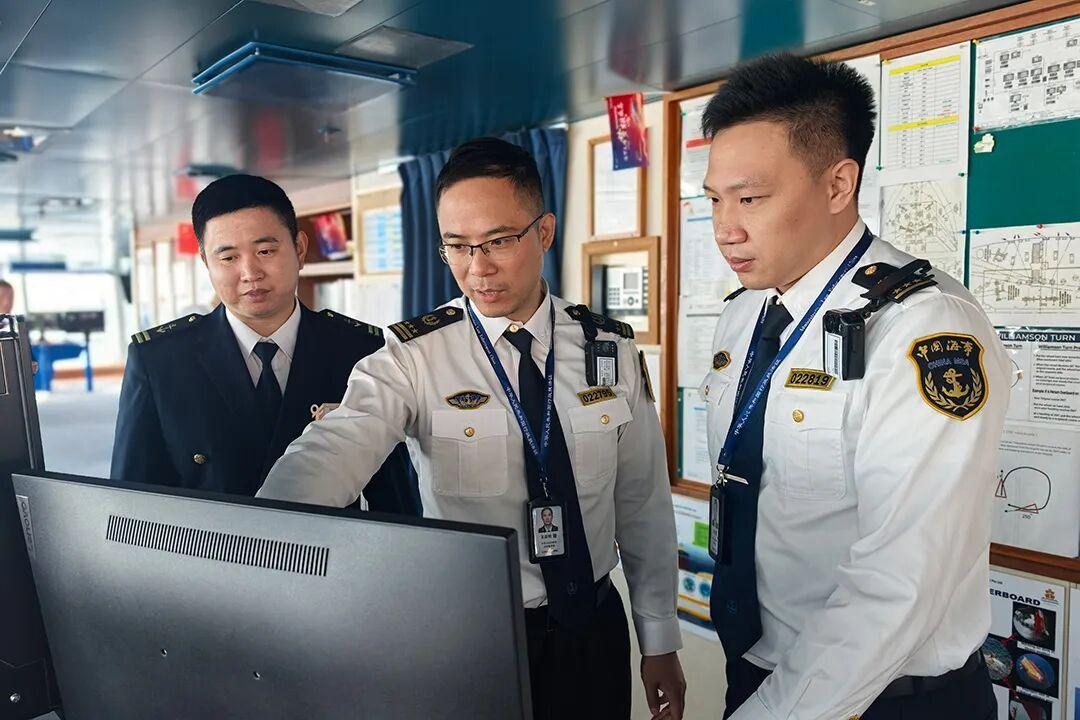
To ensure smooth and orderly high-density navigation, the Tianjin Maritime Safety Administration implemented refined scheduling of navigation organization, dynamically tracking the hydrological and meteorological changes in the port area in real-time and scientifically coordinating the sequence of multiple ships arriving and departing. It precisely avoided encounter risks, strictly enforced the "dedicated personnel, dedicated teams, dedicated responsibilities" duty mechanism, and provided point-to-point real-time warning reminders for irregular operations of fishing boats and abnormal navigation behaviors of vessels in the area, promptly eliminating all types of navigation safety hazards. Leveraging the collaborative dispatching advantages of port and shipping integration, it coordinated the entire process of piloting, tugboat support, port production, and traffic organization, prioritizing the navigation rights of passenger ships to the greatest extent, ensuring on-time docking and departure, and continually improving the travel experience for passengers.
At the same time, the Tianjin Maritime Safety Administration continued to upgrade measures to facilitate both the public and businesses, establishing a dedicated service and support liaison mechanism for passenger ships. It provided real-time connectivity for docking plans, operation arrangements, and navigational dynamics, remotely guiding ships to efficiently handle pollution prevention declarations and other services, achieving "one-stop service" for maritime management. It fully promoted the "Maritime Smart" app for online government service processing, continually compressing clearance timing and achieving “zero waiting time” for passenger ship maritime clearance.
During the docking period, the Tianjin Maritime Safety Administration strengthened the deployment of law enforcement personnel, dispatching multiple inspection teams to conduct comprehensive onboard inspections of passenger ships. Special emphasis was placed on verifying seafarers' competencies in collision prevention between commercial and fishing vessels and propagating relevant policies. Drawing lessons from recent fire accidents, it conducted comprehensive checks on key facilities such as fire safety, lifesaving equipment, and emergency response systems. Any identified hazards were rectified immediately to prevent vessels from navigating with issues. Companies were also urged to fulfill their primary responsibilities for safety production, with strict supervision and guidance provided to ensure vessels addressed collision prevention and fire risk hazards for commercial and fishing boats, fully safeguarding the area's water travel safety and stability.
For the inaugural voyage of the "New Golden Bridge V" on the Tianjin-Incheon route, the maritime authorities, while strengthening safety supervision and inspections, promptly distributed navigation safety warning materials and guided crew members in systematically familiarizing themselves with the new navigational waters. The route traverses the central Bohai Sea and Incheon waters, known for their complex navigation environment and frequent interactions between commercial and fishing boats. The maritime authorities urged shipowners to focus on mastering high-risk commercial and fishing vessel intersections, densely navigated areas, and the characteristics of fixed route navigation methods and hydrological meteorological features of the waters. High-risk collision warning zones for commercial and fishing vessels were incorporated as a core consideration in route design. Crew were organized for specialized training to ensure bridge watch personnel were familiar with VHF communication channel protocols and the principles of early, large, wide, and clear avoidance ("early, big, wide, clear"). During navigation, the bridge watch must maintain dual watchkeeping by two officers. Simultaneously, shipping companies were urged to conduct comprehensive risk assessments for the voyage and develop a "Voyage Plan" covering risk points, control measures, and emergency responses. A pre-departure self-inspection and rectification mechanism was enforced, focusing on vessel seaworthiness, crew competence, and the effectiveness of emergency equipment, ensuring vessels do not operate with maladies, thereby safeguarding the safety and smoothness of the maiden cross-border voyage.
According to statistics, during the National Day holiday, Tianjin International Cruise Home Port is expected to receive four international cruises and four passenger ferries, ensuring the water travel safety of approximately 26,000 passengers.
-
The Port of Tianjin International Cruise Terminal witnessed a “three-ship docking” event on the first day of the National Day holiday, with Tianjin Maritime authorities working tirelessly to support the waterway passenger operations peak.3368
-
September 30 International Shipping Trends5863
-
The "Standard for Hydraulic Calculation of Inland Waterway Regulation Structures" edited by CCCC First Harbor Engineering Institute has been released.3133
-
September 29 International Shipping Trends8077
-
Yangtze River Estuary South Channel Phase II Project "Builder's Home" Officially Opens4996