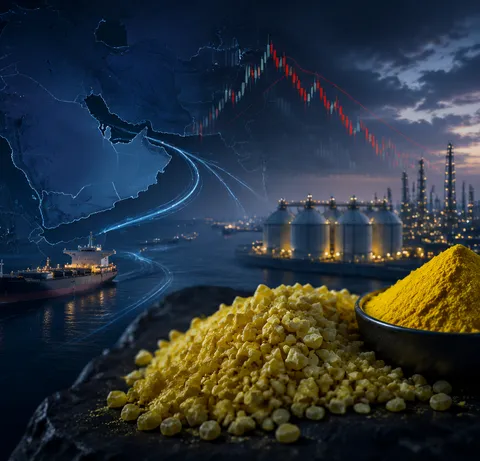
U.S.-Iran Conflict Re-Emerges, Sulfur Market Uncertainty Returns
Since the United States and Iran signed the memorandum of understanding, sulfur port prices have generally followed a volatile downward trend. Although frictions between the two sides continued during the period, they did not break the broader direction of negotiations, and navigation through the Strait of Hormuz continued to recover.
However, this week, the two sides launched the largest round of mutual attacks since the ceasefire. Both sides even publicly stated that the ceasefire agreement had ended. Concerns in the international market over navigation through the Strait of Hormuz resurfaced, international crude oil prices rebounded by nearly USD 10 from low levels, and sulfur market sentiment was also affected again. However, the impact was relatively limited, with port sulfur prices only rising slightly by around RMB 100/tonne.
Why has the impact of the current U.S.-Iran conflict on the sulfur market weakened significantly, and how should the sulfur market operate going forward?
From a trading logic perspective, the sulfur market has gradually shifted from initial panic pricing to a fundamentals-driven tug of war. The market’s desensitization to the U.S.-Iran conflict is mainly reflected in several aspects.
First is the “cry wolf” effect and sentiment exhaustion. Since the outbreak of the Middle East conflict, the market has experienced repeated cycles of “blockade, easing, and renewed conflict.” Frequent geopolitical risk shocks have gradually desensitized the market, and industry participants have generally adopted a more rational attitude.
Moreover, judging from the current situation, although both sides have used severe rhetoric, the actual scale of conflict has not expanded further for now, and market concerns have temporarily eased. In addition, geopolitical risks have already been relatively fully priced into the current market. With prices already at high levels, further upside may require new drivers.
Another key change is the suppression from negative feedback on the demand side. High prices that have continued to strengthen over the past six months have severely backfired on downstream demand. Phosphate fertilizer enterprises that purchase sulfur externally for acid production, as well as non-fertilizer enterprises outside the iron phosphate sector, are deeply trapped in losses. Their ability to absorb high-priced sulfur continues to decline.
If quotations rise sharply again due to renewed conflict, downstream industries may further cut production, suppressing demand and in turn pushing future prices down to a lower level.
At the same time, the market generally expects that after the earlier U.S.-Iran agreement, a batch of sulfur cargoes stranded in the Persian Gulf will arrive in July and August. July arrivals are expected to reach 250,000 tonnes, a clear increase from June. This expected supply increase has created some psychological pressure on the port market.
Although these arrivals cannot fully fill the market gap, the expectation of supply growth is clearly different from the earlier wartime expectation of supply reduction in terms of market psychology. Upstream sellers’ reluctance to sell may weaken, while downstream procurement enthusiasm may also decline. This pressure may only ease in stages after these cargoes actually arrive and are digested, after which the market will again assess the geopolitical situation and whether there will be new incremental supply, which will in turn affect market sentiment.
Overall, the renewed U.S.-Iran conflict brings more “uncertainty around recovery” than a “new supply crisis.” The market is more likely to show sharp volatility at high levels rather than repeat the surge seen in the first half of the year.
The future trend will depend on the tug of war between the actual pace of production recovery and cargo outflows from the Middle East, and weak downstream demand.
At present, China’s extremely low port inventory of more than 700,000 tonnes will remain a firm price support. Even if arrivals increase later, they are likely to be quickly digested by the market. Meanwhile, the global demand diversion issue remains unresolved, and China’s imports are unlikely to increase substantially. Therefore, without clear expectations for inventory rebuilding, the market does not support continued sharp price declines.
How long high prices can be maintained will depend more on the demand side’s ability to absorb them. Attention should be paid to the upcoming autumn fertilizer market. If phosphate fertilizer demand recovers in a concentrated manner and domestic refineries face greater supply-assurance pressure, market circulation prices may still have upward elasticity. However, this may also intensify cost pressure on non-fertilizer industries and lead to demand reduction. After the autumn fertilizer market ends, overall demand may weaken and suppress sulfur into a new price range.
In the medium to long term, as global supply reductions remain far greater than demand reductions, sulfur has still not entered a unilateral downtrend.
-
September 14 Urea Daily Review: Export Rumors Disturb Market Sentiment, Urea Market Consolidates Narrowly6199
-
September 14 Phosphate Fertilizer Daily Review: Cost Support Weakens Marginally, MAP and DAP Consolidate Under Pressure8658
-
September 14 Pesticide Daily Review: Stabilizing in a Wait-and-See Mode8072
-
September 14 International Fertilizer and Agricultural News6589
-
September 14 International Forex News7200