September 22 International Fertilizer and Agricultural News
Trump Seeks Potash Deal with Belarus to Weaken Canada's Market Position
Donald Trump said in a social media post that the United States was seeking to reach a potash trade agreement with Belarus, with pricing that would be more competitive than Canadian potash. Trump said the "very large" deal could allow U.S. buyers to obtain potash at prices significantly below what U.S. customers currently pay for Canadian potash. The post disclosed no details of the potential agreement. Meanwhile, trade tensions between the United States and Canada continue to escalate, and the United States is seeking an opportunity to counter Canada's retaliatory tariffs. Mosaic and Nutrien both produce muriate of potash, or MOP, in Canada, which is also the leading source of U.S. MOP imports. The first phase of Australian mining giant BHP's Jansen project in Saskatchewan, with annual capacity of 4.15 million tonnes, is expected to begin production in mid-2027. Mosaic, Nutrien, and Belarusian potash seller BPC did not comment on the reported Belarusian potash trade agreement or the potential price advantage of Belarusian supplies over Canadian potash. After a four-year gap, a 30,000-tonne vessel carrying Belarusian potash is expected to arrive at the Port of New Orleans next month. This will be the first potash trade between the two countries since the United States lifted sanctions on Belarusian potash last December. Rebuilding U.S.-Belarus potash trade would help diversify U.S. potash supply sources and reduce dependence on Canada. However, Belarusian supply volumes cannot yet fully replace Canadian supply. According to GTT data, Canadian potash accounted for nearly 90% of total U.S. potash imports in 2025, or approximately 11.2 million tonnes. GTT data also show that Belarusian MOP stopped entering the U.S. market after February 2022. Between 2017 and 2021, Belarusian MOP shipments to the United States averaged 635,000 tonnes per year. According to Belarusian state news agency Belta, Belarusian President Alexander Lukashenko said that Belarus was currently facing tight potash supply and would be unable to supply large volumes to the United States this year, as the vast majority of its products had already been committed under long-term contracts. Nutrien's current FOB quotation for granular MOP in the U.S. Midwest is USD 410/short ton, broadly in line with quotations from other suppliers.
High Prices Suppress Turkey's DAP Market
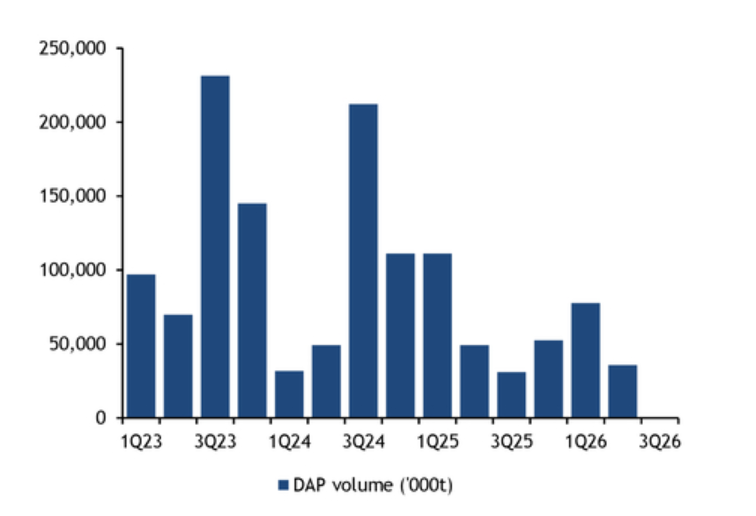
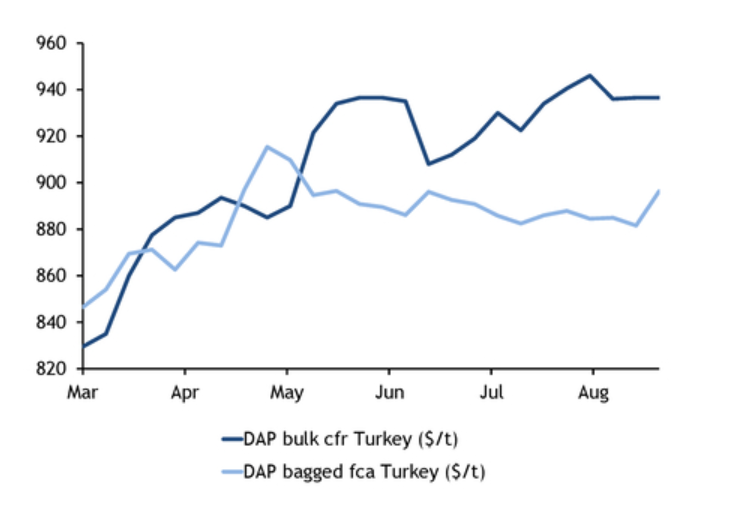
The purchasing power of farmers has been squeezed by high international prices, causing Turkey's DAP imports to fall sharply this year. Demand for phosphate fertilizers is also likely to remain suppressed. GTT trade data show that most DAP importers have remained on the sidelines since March. Arrivals from April through July this year amounted to only 43% of the average for the same period over the previous three years. Importers expect no seasonal increase in DAP imports during Turkey's September-October vegetable fertilizer season, as global DAP prices are likely to remain above domestic Turkish market prices. At the Argus Caspian, Black Sea and Eastern Europe Fertilizer Conference held on September 17-18, importers said Turkish farmers were unwilling to absorb the price increases in international markets. Argus data show that since the first assessment of bagged FCA Turkey prices was published in March, domestic quotations have remained below replacement costs. Since early June, CFR landed prices have even exceeded the bagged FCA domestic price after conversion into U.S. dollars. Moroccan supplies accounted for 57.7% of Turkey's total DAP imports in 2023-2025. However, Argus data show that Moroccan producer OCP has stopped exporting DAP to Turkey through the port of Jorf Lasfar since March. Since the first quarter, DAP export quotations have exceeded the level acceptable to Turkish importers, and trade has largely stalled. Turkish farmers have begun reducing purchases of imported DAP and switching to domestic supplies, mainly products from the local Toros and Eti Gubre plants. The Argus analysis team forecasts that Turkey's domestic DAP output will reach 517,000 tonnes in 2026, broadly unchanged year on year. Domestic production may become the main source of P₂O₅ nutrients in the market. Some farmers have also chosen alternative fertilizers, including single superphosphate, or SSP, NP nitrogen-phosphorus fertilizer, and NPK compound fertilizer. However, most importers and distributors report that total P₂O₅ application in the market will decline significantly this year. Constrained by high prices, farmers may abandon top-dressing during the vegetable-growing season. According to GTT data, Turkey's average annual DAP imports totaled 397,000 tonnes in 2023-2025. DAP imports in the first quarter of this year were 13.6% below the average for the first quarter of 2023-2025. As regional tensions continue, disruption to shipping through the Strait of Hormuz is certain to persist beyond March. International prices are expected to rise further, widening Turkey's import shortfall. Argus's assessment of Turkish DAP had a midpoint of USD 716/tonne CFR at the beginning of the year, rose to USD 813/tonne CFR in early March, and has remained above USD 900/tonne CFR since early June.
Turkey DAP Imports (kt)
Comparison of Turkey's DAP Import Prices with Domestic Prices (USD/tonne)
-
September 22 International Fertilizer and Agricultural News6709
-
September 22 International Forex News9407
-
September 22 Pesticide Daily Review: Cautious While Awaiting Changes8004
-
September 22 Phosphate Fertilizer Daily Review: Weaker Cost Support and a Soft, Divergent Sulfur Market6631
-
September 22 Urea Daily Review: Futures and Spot Prices Trade Weakly in a Narrow Range as Loose Supply-Demand Conditions Vie with Export Expectations5111