
September 29 International Fertilizer and Agricultural News
BASF Approaches Evonik Regarding Potential Acquisition: Latest Developments
German chemical giant BASF said today that it had expressed acquisition interest to domestic peer Evonik. BASF described the communication as preliminary and exploratory, emphasizing that the outcome remained uncertain. Evonik confirmed that it had received the expression of interest but stressed that the two companies were not currently engaged in negotiations. The RAG Foundation, which holds approximately 43% of Evonik’s shares, previously disclosed that BASF had approached it regarding a potential acquisition. No transaction details have yet been released. Evonik’s share price rose by more than 7% on the day of the announcement, giving the company a market capitalization of approximately €8.4 billion ($9.6 billion). Evonik is currently implementing a restructuring program that includes cutting 3,200 jobs over the next two years and discontinuing its polyester business.
Uncertainty Surrounds Australia’s 2027 Phosphate Price Outlook
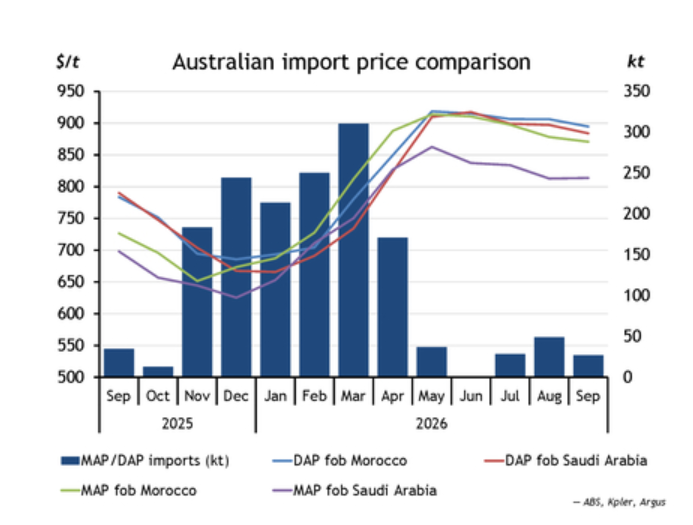
The continuing conflict in the Middle East has raised concerns in the Australian market over phosphate supplies and price trends ahead of the 2027 winter cropping season. Australian importers typically arrange for the season’s first monoammonium phosphate (MAP) and diammonium phosphate (DAP) cargoes to be loaded in November. However, persistently high global prices and increasingly bearish market sentiment have prompted importers to delay purchases. Suppliers said some Australian buyers had already secured MAP, DAP and urea cargoes in advance because of the geopolitical conflict. Others have remained on the sidelines due to uncertainty over future pricing and plan to begin purchasing only once growers generate actual demand. Since the conflict began, Australia’s MAP and DAP market has not yet entered its seasonal demand period, partly insulating domestic prices from global increases. Nevertheless, importers purchasing supplies at current international prices will inevitably have to raise their subsequent domestic selling prices. Although global phosphate prices have declined in recent weeks, they remain elevated compared with the corrections in nitrogen and potash prices. Many Australian buyers still consider phosphate fertilizers prohibitively expensive. MAP prices have risen sharply since the purchasing window closed last November. Argus most recently assessed Saudi Arabian MAP at $802–836/mt FOB, up 28% from early November last year. The Middle East is not only an important source of phosphate fertilizers but also accounts for a substantial share of global sulfur trade, with sulfur being a key feedstock in phosphate fertilizer production. Persistently high sulfur prices continue to support phosphate fertilizer production costs. Trade data from the Australian Bureau of Statistics (ABS) show that approximately 30% of Australia’s MAP and DAP imports in 2025 came from Saudi Arabia via the Strait of Hormuz. The National Farmers’ Federation told Argus on September 22 that Australian farmers would remain cautious as the next purchasing season approached because of continued price volatility. Earlier this year, Australian domestic urea prices fell sharply, leaving some market participants holding high-cost inventories and intensifying tensions between fertilizer buyers and sellers. Grain Producers Australia CEO Shona Gawel told Argus on September 22 that farmers were also highly concerned about firm fuel prices. “The main issue at present is extreme market volatility rather than a shortage of supplies. Geopolitical tensions often trigger a market reaction before any actual supply shortage emerges, rapidly driving up fuel, freight and fertilizer costs,” Gawel said.
Alternative Sources of Supply
Western Australian importer CSBP said in a market update published on September 16 that fertilizer supplies remained available to Australian importers in the global market, although the risks associated with pricing and delivery schedules had increased. ABS data show that Australia sources MAP and DAP from Saudi Arabia, Morocco, China and the United States, but most of these origins face various uncertainties. With the conflict disrupting conventional shipping routes along Saudi Arabia’s eastern coast, Australian importers have begun considering fertilizer shipments through ports on the country’s western coast. Renewed escalation in the surrounding region, however, has placed additional pressure on this alternative route. Kpler vessel-tracking data show that no vessels have yet been confirmed for this route. The latest Australian fertilizer cargo from Saudi Arabia arrived in late July. Market participants said that although phosphate fertilizer imports had declined so far this year, Australia’s domestic MAP and DAP inventories remained sufficient to meet immediate market demand.
-
September 29 International Fertilizer and Agricultural News6085
-
September 29 International Forex News5520
-
September 29 Pesticide Daily: Prices Hold Steady as the Market Waits for Direction8813
-
September 29 Phosphate Fertilizer Daily: Pre-Holiday Demand Remains Weak as Phosphate Fertilizer and Sulfur Markets Consolidate on a Soft Note8097
-
September 29 Urea Daily: Market Softens Ahead of the Holiday as Participants Await Guidance from the Indian Tender6551