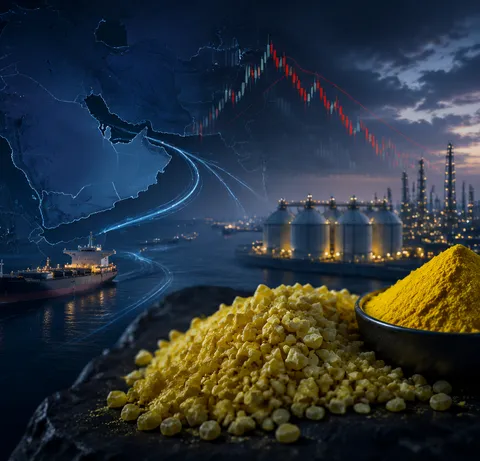
Urea: Cooling at Home, Heating Abroad - A Tug of War Toward Breakdown
This week, China’s domestic urea market showed a pattern of “broad weakness, localized breakdown.” Both spot and futures prices broke below the RMB 1,700/tonne level after an extended tug of war. In detail, the market first rebounded and then fell. The rebound was driven by a partial recovery in domestic demand, followed by a renewed macro premium from the escalating U.S.-Iran conflict. At the same time, export policy guidance became more flexible, no longer setting a fixed price ceiling and instead encouraging enterprises to export actively, which briefly improved market sentiment.
Internationally, the renewed escalation in Middle East tensions also triggered a sharp rebound, while recovery in European and Brazilian markets further supported the recovery in global urea prices. In addition, China’s inclusion of ammonium sulfate in inspection requirements also helped the international urea market to some extent, strengthening expectations for more export room for Chinese urea. Under this domestic and external resonance, the market should have strengthened, yet domestic urea prices still broke down to the downside, creating a situation of “cool at home, hot abroad.”
From a domestic perspective, fundamentals have indeed continued to weaken: supply remains high, demand recovery is poor, and inventories at producers have accumulated sharply, forcing price cuts. On top of that, pressure from physical deliveries of nearby futures contracts has also weighed on the market. These are all valid bearish factors. The only remaining support the market is relying on is exports.
However, exports have still failed to provide a clear and meaningful boost to the domestic market. The core problem is not only that export pricing restrictions make it hard to form a real competitive advantage, or that quota volume is insufficient to reverse the domestic supply-demand imbalance. A deeper issue may be that China’s position in the international market is gradually being diluted. At its root, repeated shifts in China’s export policy over recent years have made it impossible for overseas buyers to form stable expectations for Chinese supply.
Overseas buyers’ real reaction: from “prefer China” to “look elsewhere”
In March 2026, when the U.S.-Iran conflict disrupted the Strait of Hormuz, India proactively sought to resume some urea purchases from China. A senior executive at an Indian fertilizer company said at the time: “Given the current situation, we prefer Chinese supply because transit time and delivery are more predictable.” Chinese cargoes do not need to pass through the Strait of Hormuz, making them more likely to arrive on time. This was a brief recognition of China as a “geopolitical safe haven” in supply.
However, that goodwill did not last. As China’s export policy changed frequently, overseas buyers’ attitude shifted fundamentally.
Australia’s fertilizer company AFC clearly stated in its July 2026 market update: “China continued to add uncertainty.” The firm believes that the evolution of China’s export policy is a key source of uncertainty in global fertilizer trade.
StoneX also noted that the market expects China not to export urea and phosphates before August 2026, effectively removing several million tonnes of normal supply from global trade flows. Global buyers have been forced to source from a narrower group of exporting countries.
What makes buyers even more uneasy is policy unpredictability. StoneX warned that although China currently imposes export restrictions, if China reassesses inventories and demand, it could “very easily repeal that export ban.” Such a shift could trigger a rapid fall in global prices. “It can change at any time” is the most alarming signal for any buyer that needs stable supply.
Southeast Asia’s “calm”: buyers waiting, then walking away
A market report in mid-July pointed out that “the Southeast Asian urea market is relatively quiet because uncertainty over Chinese urea exports continues.” This kind of “calm” is not due to weak demand. Rather, buyers are unwilling to place orders in a policy environment that changes so often. They would rather not buy than risk signing a contract and then failing to receive the cargo.
Meanwhile, “Chinese urea export pace remains limited and has not caused a noticeable shock to the international market.” China’s export uncertainty is not only hurting its own market share, but also depriving the global market of an important price stabilizer.
Alternative suppliers are moving in
While China wavers on export policy, other suppliers are accelerating their push to capture market share:
Middle East: supply is resuming and long-term contracts are being consolidated. With the Strait of Hormuz reopened, about 500,000 tonnes of urea have already moved through the strait. Middle Eastern producers, supported by cost advantages and geographic proximity, are quickly restoring supply to Southeast Asian and South Asian markets. In February 2026, StoneX noted that Iran, the world’s third-largest urea exporter, was recovering nitrogen fertilizer production. Iran has around 9 million tonnes of annual urea capacity, and any material easing of sanctions would “materially reshape global nitrogen trade flows.”
Russia: a disruptor with unconstrained exports. Against the backdrop of frequent export restrictions introduced by China, Turkey, and others, Russia is one of the few major suppliers without significant export constraints. Russian cargoes are filling the market gap left by China, especially on the procurement lists of traditional Chinese buyers such as India.
Nigeria: new capacity is being released. As new capacity comes online in Nigeria and elsewhere, competition in South America, Southeast Asia, and Africa is intensifying. With lower natural gas costs, Nigeria is emerging as a new supply force.
The long-term cost of a “trust deficit”
The damage caused by policy instability to overseas buyer confidence is far more lasting than short-term swings in export volume:
First, long-term contracts are being lost. Overseas buyers tend to sign long-term agreements with reliable suppliers. Middle Eastern producers, supported by stable policy and cost advantages, are locking in multi-year supply contracts with Southeast Asian and South Asian buyers. China, due to policy uncertainty, is being excluded from these long-term deals.
Second, switching channels is costly. Once buyers shift procurement away from China to the Middle East or Russia, even if China later relaxes policy, switching back requires significant logistics, certification, and relationship-rebuilding costs. Lost market share is hard to win back.
Third, the “China premium” has disappeared. During geopolitical crises, China once benefited from being seen as a supplier that did not need to transit the Strait of Hormuz. But repeated policy reversals have offset that geographical advantage. Chinese supply is no longer seen as a synonym for reliability; instead, it has become a possible disruption risk.
Overall, overseas concern over the stability of China’s urea exports may already be a long-term issue, and its impact on China’s future market share could continue to intensify. At home, the core policy of ensuring supply and stabilizing prices has indeed worked well in recent years, but as the domestic supply-demand imbalance continues to worsen, falling prices are increasingly challenging that goal. In the short term, geopolitical tensions remain the key factor for any export breakthrough. If the strait remains blocked and international prices keep rising, export volume may help ease domestic pressure by leveraging temporary supply stability and competitive advantage. In the medium term, however, without additional policy support, off-season expectations and supply pressure will remain the market’s core logic.
-
September 14 Urea Daily Review: Export Rumors Disturb Market Sentiment, Urea Market Consolidates Narrowly6199
-
September 14 Phosphate Fertilizer Daily Review: Cost Support Weakens Marginally, MAP and DAP Consolidate Under Pressure8658
-
September 14 Pesticide Daily Review: Stabilizing in a Wait-and-See Mode8072
-
September 14 International Fertilizer and Agricultural News6589
-
September 14 International Forex News7200