
September 15 International Fertilizer and Agricultural News
September 21, 2026
FDD-global.com
6551
Guide
Highlights at a glance
Amid soaring sulfur prices and tight global supply due to Middle East disruptions, the U.S. government is exploring incentives to curb sulfur exports and redirect supplies to domestic phosphate fertilizer production. Sulfur, a refinery by-product, has reached record prices, forcing manufacturers like Mosaic to cut operations due to high costs. USDA Deputy Secretary Stephen Vaden outlined plans to use rail infrastructure for transporting molten sulfur efficiently, avoiding additional processing costs. While some industry participants highlight the oversupply of sulfur in North America, many support the need for policy measures to stabilize prices and sustain domestic fertilizer production, crucial for food security.
United States Considers Incentives to Restrict Sulfur Exports
U.S. Department of Agriculture Deputy Secretary Stephen Vaden told Argus in an exclusive interview that U.S. government agencies were studying ways to reduce domestic transportation costs. The objective is to encourage Gulf Coast refiners to export less sulfur and redirect supplies to domestic phosphate fertilizer production.
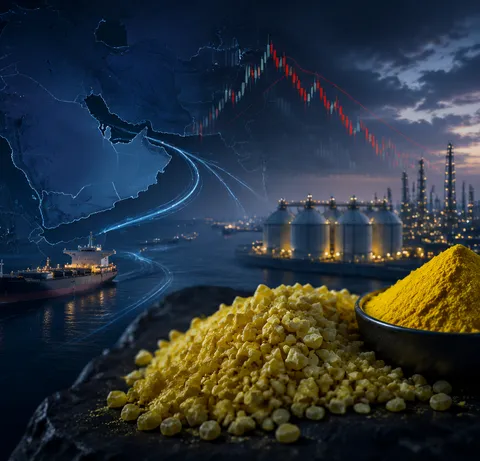
Sulfur is a refining by-product produced by U.S. refineries. With the blockade of the Strait of Hormuz disrupting other major global sulfur supply channels, U.S. refiners have become more inclined to export sulfur. This situation has pushed sulfur prices to record highs and forced phosphate fertilizer producers to reduce output.
U.S. Gulf sulfur spot prices were assessed at USD 1,000-1,050/tonne FOB last week. In the same period of 2025, prices were only USD 280-290/tonne FOB, while quotations in early January 2026 stood at USD 500-510/tonne FOB.
Vaden said the USDA was working closely with the Department of Transportation. The department has proposed using rail infrastructure to transport sulfur and introducing supporting incentives to keep sulfur in the United States.
"We not only need to retain the sulfur produced in this country, but also transport it efficiently by rail so that it does not need to be remelted when it reaches domestic fertilizer plants," Vaden said.
Most sulfur produced by Gulf Coast refineries is in molten form. Within the domestic market, it is transported mainly by rail or truck and, in some cases, by barge. Imported sulfur, by contrast, is generally granular or prilled and must be remelted before use. However, molten sulfur may solidify in transit if temperature controls fail or unloading is delayed.
The U.S. government is discussing proposals with several domestic fertilizer companies to restrict sulfur exports and ease pressure from higher procurement costs caused by tight global supply and elevated prices.
Argus understands that U.S. government officials are currently focused on lowering the cost of transporting sulfur by rail, although other details have yet to be confirmed. Sources said several government departments were working together to address the domestic sulfur challenge and were advancing the policy initiative with considerable urgency.
Vaden said the proposal would not immediately solve sulfur supply and pricing problems, but if implemented, it could resolve various sulfur-related difficulties over the next two years.
Market participants have also proposed other alternatives, including subsidy programs designed to reduce sulfur selling prices or a government-funded program modeled on India's approach that would subsidize producers' sulfur procurement costs.
U.S. phosphate fertilizer producers have recently said publicly that sharply higher raw material costs are constraining finished phosphate fertilizer production. Mosaic, a leading U.S. phosphate fertilizer producer, reduced output at all its Florida plants earlier this year and shut down phosphate fertilizer facilities at its Faustina plant in Louisiana. High sulfur costs have also prompted global phosphate fertilizer producers, including Morocco's OCP, to reduce operating rates.
The extent to which leading industry companies are participating in the government proposal remains unclear. Mosaic told Argus that ensuring more sulfur supply for domestic producers would help strengthen the resilience of the U.S. agricultural supply chain.
However, some market participants argue that the United States does not face an actual shortage of sulfur. One source said: "North America produces twice as much sulfur as it consumes. The biggest problem currently facing phosphate fertilizer production is that sulfur prices are too high. Incentives for refiners that lower sulfur prices would provide substantive benefits."
Some industry participants have nevertheless expressed concern that once sulfur prices become subject to policy controls or subsidies, other segments of the fertilizer supply chain could also be brought under government oversight.
Several members of Congress from Florida, where much of Mosaic's production capacity is located, recently sent a letter to U.S. President Donald Trump and Commerce Secretary Howard Lutnick. The letter said sulfur prices had remained at historically high levels since the outbreak of conflict in the Middle East Gulf, causing U.S. domestic phosphate fertilizer production to decline.
The lawmakers called on the U.S. government to take coordinated action to address sulfur supply disruptions and improve procurement costs. They also warned that food production could be affected if agricultural input costs continued to place pressure on the farming sector.
European Parliament Rejects CBAM Suspension Clause | Update
The European Parliament today formally confirmed its rejection of the proposed new Article 27a of the Carbon Border Adjustment Mechanism, or CBAM. The clause would have allowed CBAM to be suspended temporarily for certain products.
At the same time, the European Parliament supported expanding CBAM coverage to more than 180 additional energy-intensive downstream steel and aluminum products, including structural components, pipes, fittings, and parts.
The European Parliament's Environment Committee voted in July to extend CBAM to a broad range of downstream products containing steel or aluminum. Mohammed Chahim, the center-left Socialists and Democrats group's rapporteur in Parliament, said: "Article 27a would discourage investment in future-proof technologies and punish market participants that have already taken the lead in transitioning."
"It was precisely those who were skeptical about CBAM who approached me and asked for products under certain CN codes to be added to the regulated list," he said.
Chahim said Parliament rejected Article 27a because the clause would effectively subsidize the fertilizer industry outside the EU. He proposed using CBAM revenues to support relevant industries when they encounter severe and unforeseen difficulties.
EU member states reached a common position on the CBAM amendments in June. They also supported extending coverage to downstream products but retained a narrower version of Article 27a. Under the member states' proposal, CBAM could be suspended for specific products if their import prices increased by 50% from the 10-year average and remained at that level for six months.
An Argus analysis in June found that fertilizer products would have been highly unlikely to trigger the CBAM suspension conditions under the market conditions prevailing at the time, even if the member states' amendment had been included in the final legislation. Only phosphate fertilizer prices in certain markets had reached the proposed threshold.
In a separate vote, the European Parliament expanded the list of products eligible for support from the Temporary Decarbonization Fund, or TDF. Urea, ammonium nitrate, ammonium sulfate, and other mineral and chemical fertilizers containing nitrogen, phosphorus, or potassium were added to the list.Wheat, barley other than seed, and iron, steel, cement, and aluminum products remain eligible for support from the fund.
Members of the European Parliament want the TDF support period to run from 2027 to 2029 instead of beginning in 2028 as proposed by the European Commission. They also want downstream products made from CBAM-regulated materials to qualify for support.
Parliament confirmed its adoption of the Environment Committee's earlier decision to remove a provision that would have authorized the European Commission to consider carbon credits under Article 6 of the Paris Agreement when calculating carbon prices already paid outside the EU.
Parliament also approved a new anti-circumvention clause requiring the European Commission to monitor unusual transaction patterns and identify "artificial transaction splitting or other avoidance measures intended to keep goods below the minimum net-weight exemption threshold of 50 tonnes stipulated by the CBAM Regulation."
EU Climate Commissioner Wopke Hoekstra urged the European Parliament and member states to reach an agreement as early as possible before the end of the year.
"If no agreement is reached, the extension to downstream products may not enter into force on January 1, 2028, as originally planned," he said.
The proposal passed with 464 votes in favor, 50 against, and 159 abstentions. Following the vote, negotiations with member states on the final legislative text will begin. Member states continue to support retaining a more binding safeguard clause that would allow industries facing a crisis to suspend CBAM temporarily.
Recommended for you
-
September 15 International Fertilizer and Agricultural News6551
-
September 15 International Forex News6409
-
September 20 Pesticide Daily Review: Strength in Individual Products May Broaden Across the Market5356
-
September 20 Phosphate Fertilizer Daily Review: Weaker Raw Materials and Sluggish Demand Weigh on the Market7610
-
September 20 Urea Daily Review: Weak Pre-Holiday Order Intake Leaves the Spot Market Under Pressure and Deadlocked6306
July 9, 2026, 3:11 PM
June 22, 2026, 1:36 PM


June 25, 2026, 10:42 AM
July 1, 2026, 10:54 AM