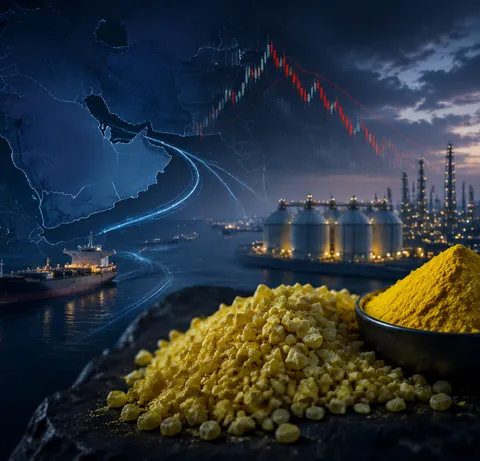
Sulfur: The Confrontation Between Receding Panic and a Structural Bottom
In late October 2026, the sulfur market sits at a position that is easily misread. Granular sulfur transaction prices at Zhenjiang Port have fallen to around 5,500 yuan/t, nearly halved from the historical peak of 11,600 yuan/t at East China ports in June; liquid sulfur in Shandong has also pulled back in tandem, with Middle East official October prices cut consecutively—Qatar FOB at $835/t and Kuwait at $820/t, both down $45 month-on-month. On the surface, this looks like a typical "the more it rises, the more it must fall" mean reversion. But if we break down the composition of the decline, what was truly dissipated is the layer of panic premium created by the Strait of Hormuz blockade in the first half of the year; whereas the supply rigidity that systematically lifted the sulfur price center, and the demand base that was temporarily suppressed by high prices, have not disappeared along with the price decline. The main thread of the current market is not "returning to the past," but the confrontation between the speed of panic receding and the structural bottom.
I. The Reality and Boundary of the Decline
The marginal rebound in port inventories is the most direct evidence of an easing supply-demand relationship. As of October 22, national port sulfur inventories stood at 1,102,900 t, up about 170,000 t from the low on September 24. The root of this change lies not in capacity expansion, but in the concentrated arrival and unloading of vessels that had been stranded overseas in the second half of the year. The return from "extreme tightness" to "no longer extreme tightness" is enough to change the perception of spot-market tightness, yet far from sufficient to declare a shift toward loose supply—the absolute level of 1.1 million t is still down more than 53% year-on-year, remaining in a historical low range.
The contraction on the demand side is more substantive. Phosphate fertilizer accounts for over half of domestic sulfur consumption and is the largest rigid base, but the surge in sulfur prices in the first half of 2026 pushed the cost share of phosphate fertilizer from the normal 25%–32% to 55%–60%; compounded by the suspension of phosphate fertilizer exports, the industry fell into deep losses. By late October, the MAP industry capacity utilization rate had dropped to 37.50%, and DAP to 39.89%, still declining month-on-month; the theoretical profit of MAP was -1,378 yuan/t and DAP -1,180 yuan/t. After autumn base-fertilizer stocking ended, the real consumption of sulfur entered a phased gap, and the perception of "strong supply, weak demand" was significantly amplified.
But the boundary of the decline is equally clear. Based on Middle East October official prices, China's landed cost is still close to $1,000/t; import costs have already inverted with domestic selling prices, and the average profit on imported material along the Yangtze coastal area has fallen to -300 yuan/t. Cost support is accumulating, and as phosphate-fertilizer winter storage gradually kicks off at the end of October, there is a possibility of phased recovery in downstream raw-material demand. This round of correction has a floor, and that floor is not in sentiment, but in the hard constraints of cost and inventory.
II. The Rigidity of Supply: A Structural Fact Obscured but Not Repaired by Panic
The core characteristic of sulfur supply was repeatedly cited when market sentiment was high, and easily forgotten when sentiment receded: about 98% of global sulfur comes from desulfurization recovery in refining, natural gas, and coal-chemical industries; output is not determined by sulfur's own price, but by the processing volume of upstream oil and gas, so the supply curve is nearly vertical in the medium term. This means any marginal increment on the demand side can only be cleared through a revaluation of prices, and a price decline itself does not shift the supply curve to the right.
The particularity of 2026 is that this rigid supply simultaneously encountered the superposition of multiple geopolitical contractions. Since late February, the Strait of Hormuz has been closed to commercial dry-bulk shipping, physically blocking about half of global seaborne sulfur trade; even as navigation gradually resumes, new loadings from the Persian Gulf remain lagging, and arriving vessels mainly reflect the clearance of previously stranded ships rather than a real recovery in production and exports. Russia's export ban, extended to December 31, 2026 by Government Decree No. 785, has reversed its role from a net exporter to a net importer; China itself has also restricted sulfuric acid exports to prioritize domestic phosphate-fertilizer and industrial demand. Argus expects global sulfur exports in 2026 to be about 14.5 million t, down 30% year-on-year, and the tight-supply situation may persist into 2027. The global supply-demand gap is expected to exceed 5 million t, the peak of the 2025–2027 cycle.
What this round of decline dissipated is precisely the extreme pricing of the "worst-case strait blockade." But the repair of Middle East capacity takes years, and the Russian ban extends at least to year-end; non-Middle East supply sources—Canada's May exports rose 68% year-on-year to 325,000 t, and Japan-Korea imports also topped the ranks in September—still cannot make up for the gap relative to Middle East seaborne volumes. Panic can recede, but the structural fragility of supply will not heal itself just because panic recedes.
III. Demand Evolution: Long-Term Increments Remain, but Short-Term Demand Is Being Suppressed in Tandem
First, the negative feedback from phosphate fertilizer is immediate and price-driven. High sulfur prices pushed phosphate fertilizer into deep losses and low operating rates, which in itself already constitutes the most direct suppression of sulfur demand. But the contraction at this level has mean-reversion attributes: as winter storage launches and prices fall back, there is room for the suppressed rigid demand to recover; it does not change the long-term structure of sulfur demand. Negative feedback from demand in non-fertilizer chemical industries also exists; unlike phosphate fertilizer, other industries' terminal demand lacks the strong seasonal rigid demand of the fertilizer industry, so the cycle from negative feedback to positive feedback is relatively longer, and no overly optimistic expectation for sulfur price recovery can be given for the time being.
In addition, new energy is the fastest-growing marginal segment of sulfur demand; in the first half of 2026, lithium iron phosphate (LFP) output grew 67% year-on-year, and Indonesian HPAL wet-process nickel forms another incremental clue. But in the current window, this steepest demand curve is being flattened.
The short-term resistance for energy storage and LFP comes more from institutional switching than from price. The monthly operating rate of LFP remains at a high of around 80%, with large plants at full production coexisting with production cuts at small and medium players, and the most active marginal procurement in the spot market comes precisely from the cost-sensitive small and medium segments. The changes on the energy-storage side are more structural: Document No. 136 cancelled mandatory storage allocation, and standalone storage lost 50%–70% of capacity-leasing revenue, with the old revenue pillar pulled away; local investigations and rectifications used hard start-up deadlines to weed out "encircled-but-not-built" projects—of 100 projects in Hebei, only 4 were successfully grid-connected, 69 were delayed, and 16 cancelled. Document No. 114 provides positive compensation through capacity electricity prices and a list system, but the compensation standard tends to fall and system operation fees inversely erode the arbitrage space, so the new revenue framework has not yet formed a stable cash flow sufficient to replace the old model in most provinces. The 18% and 16% year-on-year declines in newly added installed power and energy scale of new-type storage in the first half of 2026 are precisely the quantified result of this institutional time lag.
The energy-storage battery-cell capacity regulation announced in news on September 6 acts on a more distant link. Relevant authorities comprehensively surveyed the baseline of energy-storage battery-cell capacity, deferred approval for projects at the planning stage that had not formally started, while projects already filed and under construction were unaffected. The direct background of this regulation is that total planned capacity has exceeded 2 TWh, far exceeding real global demand. Its policy intent is not to suppress energy-storage demand, but to cut off the increment before excess capacity turns from "planning" into "sunk investment." But its short-term implication for sulfur demand is clear: the pace of forward capacity expansion in the battery-cell segment has been proactively slowed, meaning that the steepest segment of the new-energy sulfur-demand curve is having its slope policy-driven lowered. This is not the disappearance of demand, but the rationalization of the rhythm of incremental release.
Taken together: the weakness on the sulfur demand side in the second half of 2026 is a superposition of "price-driven contraction of phosphate fertilizer + institutional time lag of energy storage + preventive regulation of battery-cell capacity," rather than a reversal of the long-term new-energy narrative. The suppression of phosphate fertilizer will partly dissipate as prices fall back and winter storage launches; the time lag of energy storage depends on the pace of provincial implementing rules under Document No. 114 and the maturation of spot-market price-spread signals; and battery-cell regulation is proactive, bounded rhythm management that does not change the LFP substitution trend itself. The three together explain why, even though structural tightening on the supply side has not reversed, sulfur prices have still lost the demand-side push to keep rising—not that there is no demand, but that the release of demand has been postponed simultaneously by price, institutions, and policy rhythm.
IV. The International Situation: Pulses Recede, Friction Remains
The role of geopolitical factors in 2026 sulfur pricing is shifting from "impulse shocks" to "persistent friction." The price impulse created by the strait blockade has receded, but what it leaves behind is not a return to the old equilibrium before the conflict, but a set of friction costs that cannot be quickly eliminated: the mid-term exit of some Middle East capacity, the reshaping of Eurasian sulfur-resource flows by the Russian export ban, the systematic rise in shipping and insurance costs, and the tightening of global sulfuric-acid–sulfur chain liquidity by China's sulfuric acid export restrictions. Global sulfur trade is shifting from a unipolar "Middle East mainly supplies China" model to a multipolar competitive-pricing pattern. These frictions do not create "supply cutoffs," but they persistently embed into the price center, making any deep correction triggered by sentiment more likely a deviation than a collapse of the center itself.
Conclusion: The Endpoint of the Confrontation Is a Higher, and More Unstable, New Position
The core contradiction of the current sulfur market can be summed up in one sentence: supply rigidity is structural, demand weakness is phased, and the time scales of the two do not match. On the supply side, the by-product attribute determines that capacity cannot respond elastically to price signals; Middle East disturbances and the Russian ban continuously tighten marginal supply in the medium term, and changes on this side are measured in years. On the demand side, the suppression of phosphate fertilizer is digested on a quarterly basis, the institutional time lag of energy storage shifts with the pace of policy-rule implementation, and battery-cell capacity regulation is proactive management of the forward slope; none of the three constitutes a permanent demand collapse.
Therefore, the endpoint of this decline is not the low-level equilibrium before 2026. After the panic premium recedes, the market still faces a structure in which the supply curve is nearly vertical, the demand base has not dispersed, and new-energy increments are postponed rather than cancelled. Prices can fall by the part added by panic, but cannot break through the bottom jointly defined by structural shortage and institutional time lag. True rebalancing will be achieved as supply rigidity holds down the downside space and demand suppression gradually dissipates—what it reaches is a new position higher than the old equilibrium, with systematically elevated volatility.
-
Phosphate Fertilizer Weekly: Market Limp and Directionless, Costs Keep Sliding (2026-10-23) 016735
-
October 23 Pesticide Daily: Stabilizing and Under Observation5595
-
Sulfur: The Confrontation Between Receding Panic and a Structural Bottom9007
-
October 21 Phosphate Daily: Phosphates Hold Steady Amid Wait-and-See; Sulfur Sentiment Repairs9820
-
October 20 Pesticide Daily Review: Overall Wait-and-See, Divergence Persists6237