Greenhouse Plastic Film
6253
April 3, 2025, 10:00 AM
Guide
Highlights at a glance
This comprehensive guide explores the properties, types, manufacturing, and applications of greenhouse films. It details key polymer materials like PE, EVA, and PVC, along with performance-enhancing additives such as UV stabilizers, IR blockers, and anti-fog agents. The structure and benefits of multi-layer films are examined, alongside critical physical, optical, mechanical, and thermal properties that influence film selection. Functional classifications—including thermal, diffused light, UV-blocking, and anti-drip films—are analyzed for their impact on crop yield and quality. The report covers manufacturing methods, primarily blown and cast film extrusion, and post-treatment processes like corona treatment and coating. Installation practices across various greenhouse structures and climate-specific adaptation strategies are discussed, emphasizing regional optimization. Crop-specific applications highlight how tailored films improve production in vegetables, ornamentals, and specialty crops like cannabis and microgreens. Finally, the upstream supply chain, global manufacturing landscape, distribution channels, and end-user trends reveal market dynamics and evolving technological adoption patterns shaping the industry.

1.Basic Properties and Characterisitics
1.1 Material Composition
1.1a Primary Polymer Types
-
Polyethylene(PE): 70%-80% of greenhouse film market
-
Low-density polyethylene (LDPE): most common, 0.910-0.925g/cm³
-
Linear low-density polyethylene (LLDPE): 0.915-0.935g/cm³
-
High-density polyethylene (HDPE): 0.941-0.965 g/cm³
-
-
Ethylene-vinyl acetate copolymer (EVA): 5-20% vinyl acetate content
-
Polyvinyl chloride (PVC): decreasing market share due to environmental concerns
-
Ethylene-butyl acrylate copolymer(EBA): Specialized applications
-
Polycarbonate (PC): high-end greenhouse coverings
1.1b Additives and Modifiers
-
UV stabilizers: Hindered Amine Light Stabilizers(HALS), benzophenones, benzotriazoles, 0.5-2.0% concentration.
-
Infrared (IR) additives: Metal oxides, silicates, 1-5% concentration
-
Light diffusion agents: CaCO₃, talc, TiO₂, 2-10% concentration
-
Anti-fog/Anti-drip agents: Glycerol esters, ethoxylated alcohols, 0.5-2.0% concentration
-
Anti-dust additives: Silicone-based compounds, 0.1-0.5% concentration
-
Flame retardants: Brominated compounds, phosphorus-based additives
1.1c Multi-layer Film Structure
-
Monolayer: Single polymer with additives, 80-150μm thickness
-
3-layer films: Typical structure- outer layer (UV protection), middle layer (strength), inner layer(IR, anti-fog)
-
5-layer films: Enhanced performance, specialized barrier properties
-
7-9 layer films: Advanced barrier properties, specialized applications
-
Layer thickness ratio: Typically 15/70/15 for 3-layer films
1.2 Physical Properties
-
Thickness Range
-
Seasonal films: 30-100μm
-
Multi-season films: 100-200μm
-
Long-life films: 180-250 μm
-
Regional Variations: Thinner in warm climates(60-120μm), thicker in cold regions(150-220μm)
-
Thickness tolerance: ±5% within roll, ±10% between manufacturing batches
-
-
Optical Properties
Property Standard Film Diffused Film Thermal Film PAR Transmission (400-700 nm) 85-92% 80-88% 82-89% UV Transmission (280-400 nm) 15-80% 10-70% 5-60% IR Transmission (7-14 μm) 60-80% 60-80% 20-40% Haze 10-30% 50-80% 20-40% Light Diffusion 20-30% 60-85% 30-50% -
Mechanical Properties
Property LDPE LLDPE EVA (12% VA) Tensile Strength (MD/TD, MPa) 20-28/16-24 35-45/25-35 25-32/20-28 Elongation at Break (MD/TD, %) 300-500/400-600 600-800/700-900 500-700/600-800 Tear Resistance (MD/TD, g/μm) 2-4/8-12 8-12/15-25 5-10/12-20 Dart Impact Strength (g/μm) 2-4 6月10日 8月15日 Puncture Resistance (N/mm) 10-20 25-40 30-45
Note: MD = Machine Direction TD= Transverse Direction
-
Thermal Properties
-
Operating temperature range: -40°C to +60°C (standard films)
-
Heat retention coefficient: 15-20% (standard film), 55-65% (thermal film)
-
Thermal resistance (R-value): 0.83-0.87m²·K/W (single layer), 1.4-1.7 m²·K/W (double layer with air gap)
-
Temperature difference (inside vs. outside): 1-3°C (standard film), 3-8°C (thermal film) during night
-
Heat capacity: 1.9-2.3 kJ/kg·K (PE films)
-
-
Aging and Durability
-
Service life: 1 season (6-9 months) for standard film, 2-3 years for multi-season 4-5+ years for long-life films
-
UV degradation rate: 5-10% loss in tensile strength per month of exposure without stabilizers
-
Retention of light transmission: 90-95% after 1 year, 80-85% after 3 years, 70-75% after 5 years
-
Weatherability (desert conditions): Service life reduced by 30-50%
-
Cold region performance: Becomes brittle below -30°C for standard PE, -40°C for premium films
-
1.3 Chemical Properties
-
Chemical Resistance
Chemical Agent LDPE EVA PVC Acids (weak) Excellent Excellent Good Acids (strong) Good Good Poor Alkalis Excellent Excellent Good Alcohols Good Fair Good Pesticides Good-Excellent Good Good Chlorinated compounds Poor Poor Poor Petroleum products Poor Poor Poor -
Surface Properties
-
Surface energy: 30-32mN/m (LDPE), 33-36 mN/m (EVA)
-
Water contact angle:90-100° (untreated), 50-70° (with anti-fog additives)
-
Surface resistivity:10¹²-10¹⁵ Ω/square
-
Coefficient of friction: 0.2-0.3 (untreated), 0.1-0.15 (slip additives)
-
Dust adhesion index: 6-8 (standard film), 2-4 (anti-dust films), scale 1-10
-
2.Types and Classification
2.1 Classification by Functional Properties
-
Standard (clear) Films:
-
Composition: Primarily LDPE/LLDPE
-
Light transmission: > 85% PAR
-
Haze value:
-
Applications: Basic crop protection, short growing seasons
-
Market share: 35-40% of greenhouse film market
-
Thermal/IR Films
-
Composition: PE/EVA with mineral IR additives or PE/EVOH layers
-
Wavelength blocking: 7-14μm (far infrared)
-
Heat retention improvement: +30-50% compared to standard film
-
Night temperature benefit:+2-5°C versus standard film
-
Cost premium: 20-35% over standard film
-
-
Diffused Light Films
-
Composition: PE/EVA with light diffusion additives(typically CaCO₃, talc)
-
Haze value: 50-80%
-
Direct/Diffuse light ratio: 30/70 to 15/85
-
Yield improvement: 5-15% for shade-intolerant crops
-
Light penetration into canopy: 30-50% deeper than standard films
-
-
UV-Blocking Films
-
UV transmission:
-
Pest reduction: 30-60% decrease in certain insect populations
-
Fungal disease reduction: 20-45% less powdery mildew incidence
-
Limitations: May reduce pollinator activity, certain crops require UV
-
-
Anti-Drip/Anti-Fog Films
-
Surface tension: >50 mN/m (treated surface)
-
Water contact angle:
-
Light transmission benefit: +5-10% compared to drip-covered standard film
-
Condensation pattern: Film formation rather than droplets
-
Duration of effectiveness: 1-3 years
-
Colored and Spectral-Selective Films
-
Types: Red, blue, pearl, silver, fluorescent
-
Red Films: R:FR ratio 1.1-1.4 (standard film 1.0-1.1)
-
Blue Films:Enhanced B:R ratio, typically 0.45-0.55 (standard 0.25-0.35)
-
Pearl/white films: Reflection 30-45% (vs.10-12% for clear)
-
Applications: Plant height conrol, flowering manipulation, insect management
-
Yield effects: Highly crop-specific, -10% to +15% depending on crop/color
-
2.2 Classification by Polymer Structure
-
Single Polymer Films
-
Primarily LDPE (70-80% of market)
-
Thickness: 30-200μm
-
Manufacturing: primarily blown film extrusion
-
Cost: lowest among greenhouse films
-
Service life: 6-12 months without additives
-
-
Copolymer Films
-
EVA (vinyl acetate 5-18%)
-
EBA (butyl acrylate 5-15%)
-
Thermal properties: improved over homopolymers
-
Clarity: superior to pure PE films
-
Flexibility at low temperatures: remains flexible to -30°C with 12% VA content
-
-
Multi-layer films
-
Layer bonding: coextrusion with tie layers when needed
-
Performance: each layer optimized for a specific function
-
Market trend: growing at 12-15% annually, faster than single-layer
-
Cost premium: 25-50% over monolayer films
-
2.3 Classification by Duration/lifespan
-
Seasonal Films(6-12months)
-
Composition: primarily LDPE with basic UV stabilizers
-
Thickness: 30-100μm
-
UV stabilizer package: 0.5-1.0%
-
Applications: Annual crops, low-cost operations
-
Regional usage: dominant in developing countries, southern regions
-
-
Multi-Season Films (2-3 years)
-
Composition: LDPE/LLDPE blends, often with EVA
-
Thickness: 120-180μm
-
HALS concentration: 0.8-1.5%
-
Light transmission after 24 months: minimum 80% of initial
-
-
Long-life films(4-5+ years)
-
Composition: premium PE blends with EVA/EBA, multi-layer
-
Thickness: 180-250μm
-
UV stabilizer systems: complex packages with synergistic effects
-
Metal deactivators: 0.1-0.3% to prevent catalyst-induced degradation
-
Warranty periods: Typically 4-5 years in temperate climates
-
3.Manufacturing Process
3.1 Basic Production Methods
-
Blown Film Extrusion
-
Market share: 85-90% of greenhouse films
-
Extrusion temperature: 160-220°C
-
Die Gap: 0.8-2.5 mm
-
Blow-up ratio (BUR): 1.5-3.0
-
Line speed: 20-150 m/min depending on thickness
-
Air ring cooling systems: Dual-lip or triple-lip designs
-
-
Cast Film Extrusion
-
Market share: 10-15% of greenhouse films
-
Applications: mainly specialized high-clarity films
-
Extrusion temperature: 180-240°C
-
Chill roll temperature: 20-40°C
-
Advantages: Superior optical clarity, thickness consistency
-
Limitations: generally lower impact strength than blown films
-
-
Multi-layer Coextrusion
-
Layer thickness ratio control: ±5% accuracy
-
Interfacial surface quality: critical for optical properties
-
Processing challenges: matching rheological properties between layers
-
Layer adhesion strength:typically 3-5N/15mm for compatible polymers
-
3.2 Post-Production processing
-
Corona Treatment
-
Surface energy increase: from 31-32mN/m to 42-56 mN/m
-
Treatment levels: 38-45 dyne/cm for printing applications
-
Aging of treatment: 30-50% loss of effectiveness within first month
-
Applications: improving anti-fog performance, printability
-
Power requirements: 2-5W/m²/min
-
-
Surface Coating Application
-
Coating types: anti-fog, anti-dust, anti-viral
-
Application methods: offline roller coating, spray systems
-
Coating thickness: 1-5μm
-
Adhesion requirements: 4B rating (ASTM D3359)
-
Durability: 1-3 growing seasons
-
-
UV Curing Processes
-
Applications: specialized hardcoatings, anti-abrasion treatments
-
UV dose: 100-300mJ/cm²
-
Cure speed: 5-30 m/min
-
Coating Thickness: 3-15μm
-
Marketing segment: Premium greenhouse films, 2-5% market share
-
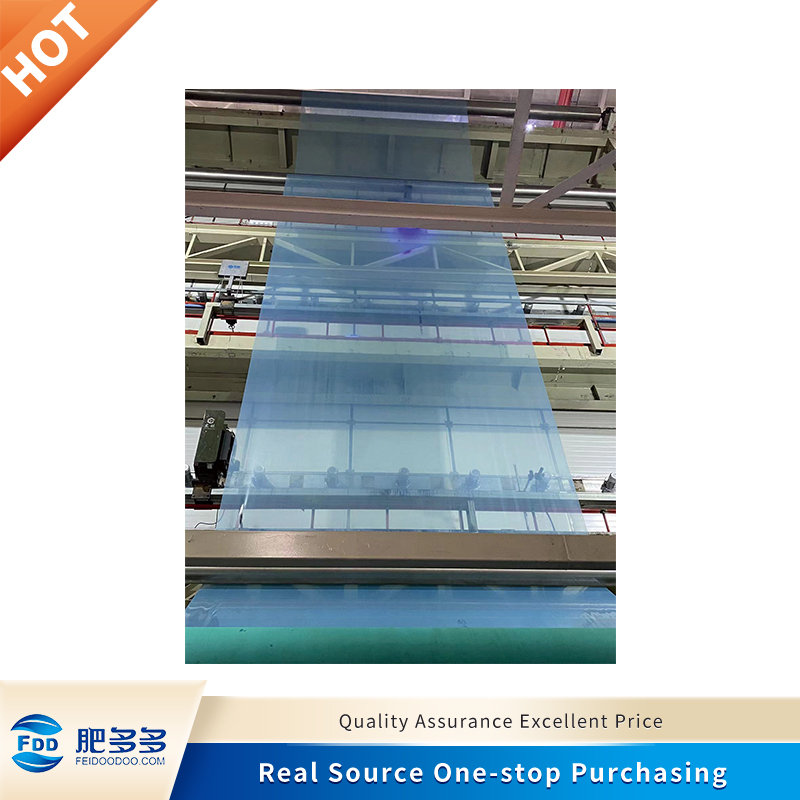
FDD 100/120/150/180/200/250 Micron Anti-Drip 5 Layers UV Resistant Clear Greenhouse Plastic Film
$ 0.4
/Square Meter
MOQ: 1Square Meter
Product Model: FDD-greenhouse UV plastic film
Supplier Profile
Ningbo Feidoodoo E-Commerce Co., Ltd
Established: October 10, 2019
Company Size: 500
Get Best Price
4.Applications and Usage Methods
4.1 Greenhouse Structures and Installation
4.1a Greenhouse structure compatibility
-
Single-span tunnels: films 120-180μm, 4-12m width
-
Multi-span greenhouses: films 150-200μm, typically 8-16m width
-
Film lifespan correlation with structure: Metal structures with sharp edges reduce life by 15-30%
-
Attachment systems: wiggle wire/channel (40-50%), batten tape (20-30%), lock profiles(15-20%)
-
Installation tension: 3-5% elongation recommended (varies by structure)
4.1b Multi-layer installations
-
Double-layer inflated systems: 0.3-0.5 kPa air pressure
-
Air gap optimization: 8-10 cm ideal spacing
-
Energy savings: 35-45% versus single layer
-
Condensation management: Critical between layers
-
Blower systems: 25-60W fans, 0.1-0.3 air changes per hour
4.1c Regional Adaptation Strategies
| Climate Zone | Recommended Film Type | Thickness | Special Feature |
| Mediterranean | EVA 12-16% | 180-200 μm | IR, Anti-drip |
| Northern Europe | EVA 14-18% | 200-220 μm | High IR retention, Anti-condensation |
| Desert/Arid | PE/EVA with additives | 150-200 μm | UV resistance, NIR reflection |
| Tropical | PE with UV stabilizers | 150-180 μm | UV blocking, Anti-fungal |
| High Altitude | EVA >12% | 180-220 μm | UV resistance, IR retention |
4.2 Crop-specific applications
-
Vegetable Production
-
Tomato: diffused light films increase yield 7-12%, improve quality
-
Cucumber: anti-drip films critical, 8-15% yield increase
-
Pepper: thermal films extend season by 2-4 weeks
-
Leafy greens: UV- Blocking films reduce tipburn by 30-60%
-
Strawberry: Red-tinted films increase sugar content by 5-12%
-
-
Ornamental Production
-
Flowering Regulation: blue-tinted films increase flowering in short-day plants
-
Plant height control: Far-red filtering films reduce stem elongation 15-25%
-
Rooting improvement: pearl films increase root mass 10-20% in cuttings
-
Quality factors: UV-transmitting films improve color development in read varieties
-
Season extension: thermal films allow 3-5 weeks earlier production in spring
-
-
Speciality Applications
-
Medicinal cannabis:Diffused films with UV-A transmission optimize cannabinoid profiles
-
Microgreen production: blue-enhanced films increase anthocyanin content 25-40%
-
Tissue culture hardening: Gradient UV-permeable films for acclimatization
-
Nursery propagation: Anti-corrosion films with specialized additives
-
5.Upstream and Downstream Industry Relationships
5.1 Upstream Raw Material Supply Chain
5.1a Polymer Resin Production
-
LDPE global production: ~25 million tons/year, 5-8% used in agricultural films
-
LLDPE for films: C4, C6, and C8 co-monomer types
-
Resin pricing factors: Ethylene price (60-70% of cost), energy costs (10-15%)
-
Price volatility: PE film-grade resin varies 15-30% annually
-
Major producers: ExxonMobil, SABIC, Dow, LyondellBasell, INEOS, Sinopec
-
Regional capacity: Asia-Pacific (45%), North America (25%), Europe (20%), others (10%)
5.1b Raw Material Quality Impact
-
Resin Melt flow rate(MFR) variation: ±10% typical between batches
-
Molecular weight distribution effects: Narrower MWD improves optical properties, reduces mechanical strength
-
Catalyst residue effects: Titanium residues accelerate UV degradation
-
Additive compatibility issues: Interaction between HALS and Sulfur-containing pesticides
-
Quality control parameters: Gel count
5.1c Supply Chain Challenges
-
Polymer Supply volatility: 15-25% price fluctuations annually
-
Additive lead times: specialized additives 4-12 weeks
-
Force majeure incidents: Average 3-5 major supply disruptions annually in PE industry
-
Raw material traceability: increasingly required for food-contact applications
5.2 Manufacturing Ecosystem
5.2a Film Extrusion Industry Structure
-
Global Capacity: 1.2-1.5 million tons/years for greenhouse films
-
Industry concentration: Top 10 manufacturers represent 40-45% of the market
-
Regional Production Capacity:
Region Share Annual Growth Specialization Asia 52% 7-9% Standard films, multi-layer Europe 22% 2-3% High-performance, specialty films North America 14% 3-5% Multi-layer, long-life films Middle East 8% 6-8% Standard films, UV-resistant Others 4% 4-6% Varies by market
5.2b Technology Development Relationships
-
Resin supplier-film manufacturer cooperation: 75% of new formulations
-
Additive supplier innovation role: Critical for 80% of performance improvements
-
Equipment manufacturer contribution: Enabling multi-layer technologies
-
University/research institute partnerships: Present in 30-40% of major innovations
5.3 Downstream Distribution and End Users
5.3a Distribution Channels
-
Direct sales to large growers: 15-20% of volume
-
Agricultural distributors/dealers: 45-55%
-
Greenhouse manufacturers: 15-20%
-
Retail/garden centers: 5-10%
-
Online sales: Growing at 20-25% annually, currently 5-8% of the market
-
Regional distribution models:
Region Primary Channel Secondary Channel Trend Europe Specialized distributors (60%) Direct sales (25%) Increasing consolidation North America Ag dealers (50%) Greenhouse builders (30%) Growing online sales Asia Local distributors (70%) Direct import (15%) Emerging organized retail LATAM Agricultural dealers (65%) Direct import (20%) Increasing technical support
5.3b End User Segmentation
-
By operation size:
-
Large commercial (>10 hectares): 25-30% of market volume
-
Medium commercial (1-10 hectares): 40-45%
-
Small Commercial (
-
Research/institutional: 5-10%
-
By crop type:
-
Vegetables: 55-60%
-
Ornamentals: 15-20%
-
Fruits & berries : 10-15%
-
Nursery/propagation: 5-10%
-
5.3c User requirements and Trends
-
Film Selection drivers(ranked):
-
Durability/lifespan
-
Cost-performance ratio
-
Optical properties
-
Thermal properties
-
Special functionalities
-
-
Service requirements
-
Technical support: Critical for 60-70% of medium/large users
-
Warranty terms: 85-90% of users consider essential
-
Local availability: 50-60% won't switch if requires import
-
Custom dimensions: required by 30-40% of users
-
-
Technology adoption patterns
-
Early adopters: 10-15% of users
-
Majority adopters: 45-55%
-
Late adopters: 30-40%
-
-
More Sourcing News
77667
July 4, 2025
73940
July 10, 2025
71856
July 10, 2025
64675
July 4, 2025
61906
July 10, 2025